~Slides for Kindergarten and 1st graders~
Calder Project
example pictures at end of slides
Extra instructions from Training night at end of Slides

Calder Project
example pictures at end of slides
Where do we usually see art?
The first thing you may think of might be an art museum. What about, on the walls of our homes, or in businesses, or doctor/dentist office? Sometimes furniture is carved or molded in unusual and creative ways, light fixtures or lamps can become works of art. Fabrics are made using art, think about the images, or patterns on pillows or blankets. What about statues of famous people or animals?

What is Public Art?
Public art is visually and physically accessible to the public – it is installed or staged in public spaces, usually outside. Art for public spaces enhances the experience of that space, inspiring pride and contributing to a deeper understanding of our community. It often relates to the history, culture, or mythology of the area.

This fun sculpture is part of Jim Griffith Memorial Skatepark, a 15,000 SF concrete park named after late mayor Jim Griffith, who was an advocate for Tigard youth and the skate park project. Fun fact: Jim Griffith Memorial Skatepark was designed and built by Dreamland Skateparks. Raise a quiet hand if you have seen the dinosaur sculpture.


Los aborígenes~
Capas y capas de Crayones
Mirando y Pensando
Mirando y Pensando Los aborígenes fueron los primeros en vivir en Australia. Los historiadores creen que el Aborigines llegó a Australia más de 40,000 años atrás. El arte realizado por estas personas se puede encontrar en cuevas,, en piedra y en trozos de corteza. Los Aborígenes hicieron pinturas usando moras y otras plantas en la naturaleza. Después utilizaron las pinturas para colorear diseños imaginativos.


Aboriginal Art~
Layers and Layers of Crayon
Looking and Thinking-
The Aborigines were the first people to live in Australia. Historians believe the Aborigines reached Australia over 40,000 years ago. The art made by these people can be found in caves, on stone, and on piece of bark. The Aborigines made paints from berries and other plants in nature. Then they used the paints to color imaginative designs.

This is an aboriginal bark painting. It was painted a long time ago. What colors does it have? Can you see these colors in nature? Describe the kind of shapes and lines used to make the bark painting.

A student artist like you made this piece of art. Does it remind you of Aboriginal art? The artist used crayons and paper instead of paints and bark. Things like paint, crayons, and clay are called media. They are an artist's materials. Can you see how different media change the way art looks?
ART MATERIALS NEEDED-
White paper
Crayons
Paper Towels
Scissors
Making Art
1. Begin your bark painting by covering a sheet of paper with yellow crayon. Use short, quick strokes to cover the paper. Press down on the crayon.
2. On top of the yellow crayon, add a layer using orange crayon. Use quick strokes, and cover the whole page. Don't press down on the crayon quite as hard as you did on the yellow crayon. You don't want to break through the yellow layer.
3. Do three more layers in this order: Red, Brown, Black. (Would the Aborigines be able to use the colors you use?) Then rub the surface of your art with a paper towel.
4. Now use your scissors to etch a design in the crayon layers. Use the Points of the scissors to etch lines. Use the edges of the scissors to etch out solid areas or shapes. Keep your design simple. Think about how the Aborigines' designs looked.
5. Study your artwork when it's complete. Can you see the colors of crayons where you etched? How is your artwork like Aboriginal bark painting? How is it different?
It’s time for Art
Lit!

Inspired by
Illustrators
If
you do not have the materials for this project at home, use what you do have.
Just get creative!
Zen Doodle Art Lit
Project Inspiration
An
illustrator is an artist who draws
or creates pictures for magazines, books, advertising, etc.
Some
examples are:
Day and Night by M.C Esher

The Tale of Squire Nutkin by Beatrix Potter

Wild Rumpus by
Mauric Sendak (Where the Wild Things Are)

Examples of Zen
Doodles by Paula Dickerhoff:
Who Says the Owl
 |
| Add caption |

Materials Needed:
Paper
Pencil
Black
marker
Optional
items: colored pencils, markers, crayons
Project, step by
step directions:
Step 1
Practice different doodle patterns.
On
a piece of blank paper, practice some of the base doodle shapes and patterns.
(See directions below.)
a)
Raindrop
b)
Rainbow
c)
Circles,
squares, triangles
d)
Spirals
e)
Wavy
Lines, Zig Zag Lines
f)
Hashing
lines

Raindrop
Draw
a raindrop shape.
Start
at the tip, follow the shape, and draw another, larger raindrop around the
first one.
Keep
repeating until you are happy with the size.


Rainbow
Draw
a small, upside down U shape.
Draw
a larger U shape, following the same shape as the first one.
Keep
repeating until you are happy with the size.


Circles, squares,
triangles
Draw
a circle, square, or triangle.
Draw
a smaller circle, square, or triangle inside the larger one.
Keep
repeating until you are happy with the size.

Spirals
Draw
a circle that does not fully touch, start to curve in, toward the center.
Try
a square or triangle.

Wavy lines and Zig
Zag Lines
To
fill a cell or space, use your pencil/pen to draw a wavy line.
Try
thick lines, thin lines, drawing the wavy lines close together or farther
apart.


Hashing lines
Draw
four short lines, one over the other to make a square.
Draw
four short lines, next to each other to make a square.
Repeat,
drawing the blocks of lines close to each other.


Step 2. Choose your subject.
On a new piece of paper, use a pencil to
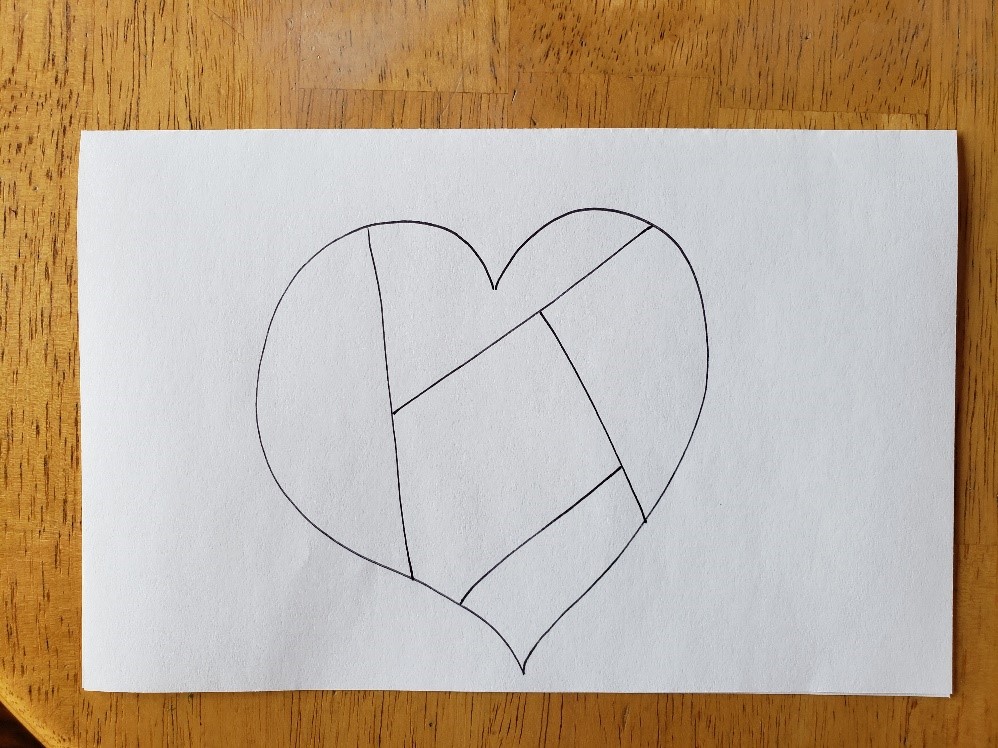
lightly draw a large, simple subject; fish, butterfly, flower, heart, bird,
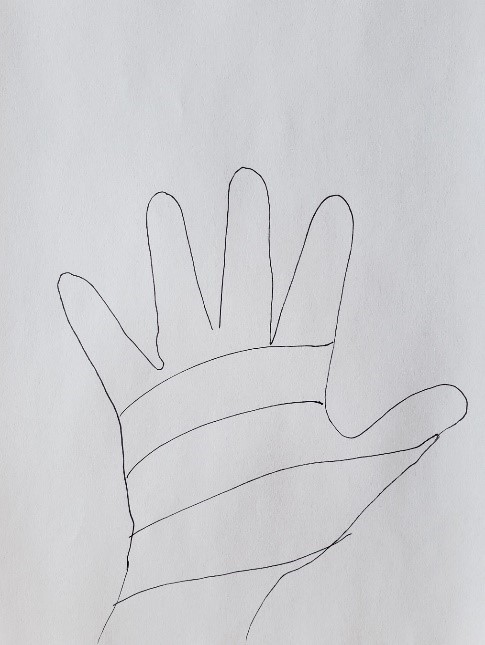
trace your hand (Or, an adult’s hand! It will be larger).


Step 3
Trace the shape with a marker, pen or Sharpie.
Step 4
Draw lines
to create cells or shapes.

Step 5
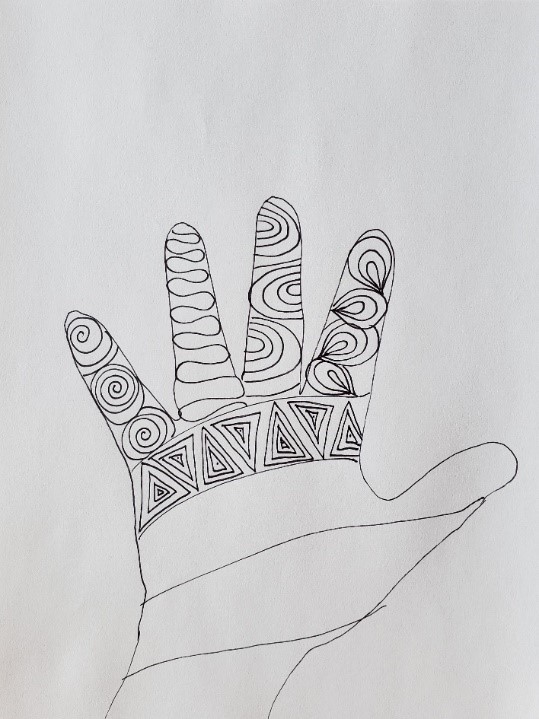
Choose any
of the Zen Doodle patterns from your practice page to fill in the open shapes.


Step 6
Keep going
until all of the cells are filled. Then, make some lines thicker, add dots or
extra lines, add a smile.


You can use
markers, colored pencils or crayon if you want to color your Zen Doodle!


