Pages

Tuesday, April 5, 2016

Here is our last artist of the 2015-2016 school year!! 
Calendar is at the bottom of post!  

ABORIGINAL ART

All aboriginal art is an expression of Aboriginal Dreaming. Traditionally, Aboriginal people from central Australia used sand and body painting combined with song, dance and story. Aboriginal music plays a strong role in Aboriginal culture. Aboriginal people 'sing their country' in ceremony that combines song, dance and art. Each Dreaming has an associated song, and paintings should be seen in the context of the song and dance that accompanied the production of that work. 

  Photograph of Paddy Stewart Japaljarri, 1995

Artist, Paddy is standing in front of the community art center of Yuendumu.  Paddy is from Mugapunju, just south of Yuendumu.  When he was a young man, he was a station worker at Mt. Allen and Mt. Dennison.  He worked as a chef in Papunya, hence his nickname  "Cookie".  He has lived for a very long time in Yuendumu.  Cookie worked at the Yuendumu School teaching young kids, both non aboriginal and aboriginal culture (kardiya and yapa). He's taught painting, dreaming (jukurrpa), tracking (dingo, kangaroo, goanna, etc..), how to make wax for the sand painting, dancing, making boomerangs and many other important cultural traditions. 

He has been drawing and painting for a long time, including work on the Yuendumu School doors which he was commissioned to do in 2000.  He produced 30 etchings of the original Yuendumu Doors in collaboration with Paddy Sims under the guidance of Basil Hall. Northern Editions Printmaker (Northern Territory University). 

He also has served as the chairman for the Warlukurlangu Artists Committee. In 1988, his work received world wide acclaim when he was selected by The Power Gallery, Sydney University , to travel to Paris with five other men from Yuendumu to created a ground painting installation at the exhibition "Magiciens de la Terre" at the centre Georges Pompidou.  The trip took place in May 1989.


 Photo of Pansy Napangarti, Alice Springs, 1994

Many of the Australian Aboriginal artist are women.  Many people believe that the patterns and symbols used in this art are  "random" and/or "abstract", however it is usually well structured with may recognizable symbols used to represent men, women, babies, creatures both in their daily lives and mythical traditions, along with features of their country. 

Pansy is painting in her back yard. Pansy is from Papunya, West of Alice Springs, Central Australia and was known as one of the leading foremost women artist of Papunya Tula Artists. Pansy has exhibited her works from 1988-1992. Notice Pansy's paint tin contains both white and yellow paint, used in her distinctive half-tone dotting style. Pansy's work is meticulously dotted, often taking many hours or even days of intense concentration to execute a painting. Her Dreamings include: Bush Banana, Water Snake, Kangaroo, Cockatoo, and Bush Mangoe from her Father's side, and Two women, Seen Sisters, Hail and Desert Raisin from her Mother's side. 

 Carpet snake Dreaming, 1987, by Billy Stockman Tjapaltjarri

This dreaming is near Ylpana, or Mt. Denison.  This is an important dreaming site to men of Tjungurrayi/japaltjarri skins.  The carpet snake is seen encircling his home, the central circles.  Men perform ceremonies here today.  The linked background circles are of symbolic meaning and used as body paint designs during ceremonies.  Billy was born in 1927 and is one of Central Australia's grand Old Masters and highly respected artists.  Billy is one of the senior keepers of all his tribe's Dreamings.  He has painted Budgerigar, Spider, Yam and Wild Potato Dreamings for his region. 

Billy was raise by his aunt after his mother was killed during the Coniston massacre of 1928 when the area was invaded by whites.  He began work as a stock-man and later worked as a cook in the Papunya communal kitchen.  He was one of the Papunya Town Councilors in the 1970's and an accomplished wood carver before he took up painting. Billy was one of the founders of the Papunya painting movement after he received approval to use guarded stories.  It was then that he and a few others painted the Honey Ant Dreaming design on the school which set the painting movement in motion. 

Billy was a Central Australian delegated to the NAC during the '70's. Aboriginal Arts Board member 1975-79; and Chairman of Papunya Tual Artists during the '70s.  He has exhibited his work form 1974 to 1994, and has visited the USA several times. In 1988, he was part of the opening of the "Dreamings: Art of Aboriginal Australia" exhibition in New York.  He and his wife have four children; two daughters and two sons.  The daughter, Gillian paints occasionally having been taught by her father. 
 Aboriginal People during Ceremonial Dance 

Notice all the dotted work of body paint-similar to what we see on many canvas paintings. 


 Bush Bean Dreaming, 2003, by William Sandy, 60" X 48" 

Born in 1944, and had his first solo exhibit in 1990.  Participated in group exhibits from 1982-2000, and was the winner of the Northern Territory Art Award in 1985.


 Rainbow Dreaming, by Peggy Nangala Jurra, 1987, Synthetic Polymer paint on canvas, 106.7 X 76.5 cm and Bush Potato Dreaming, by Leo Peterson. 

Rainbow Dreaming is associated with the Water Dreaming that also belongs to Nanagala and Nampitjinpa women.  The country of the Dreaming is Puyurru where a big rain left to travel north in the Dreaming.  As the rain traveled, the Dreaming created people out of the small rain clouds.  

The Path of the Dreaming follows a creek with a fresh-water spring, called Lungkardajarra, shown by the central wavy lines.  The central circles represent big clouds; the outer circles, small rain clouds and the bars indicate cloud fronts.  The Rainbow Dreaming is indicated by tri-colored arcs, which are painted in primary colors to emphasis its radiant power.  

 From the Tingari Cycle, Morris Gibson Tjaplatjarri, 2003, 
60" X 48" 

 John Weeronga Bartoo's work and unknown artist

Artist statement: I am an Australian Aboriginal Artist, my Mob come from around Cunnamulla in South Western Queensland.  It was late in 2002 while recovering from illness that I felt an urge to paint.  At that time I did not understand where this feeling came from.  Through my art I am learning more about my culture, promoting my art and communicating with people is giving me more confidence in myself.  I paint primarily for myself and am happy when others enjoy my work.   I
believe that the spirits of my ancestors are guiding me with my art and through my art.  I can express the stories of not only the Dreamtime but of my family and my life's journeys.  As for my future in art, I will be guided by my heart and the spirits.

 Flying Dingoes, 1974 and Honey Ant, by the Papunya Community 

 Bark Paintings: Fish and Black Headed Python and fruit Bats

During the flowering season in September, "flying foxes" are attracted to the blossoms on certain trees.  When they root, their droppings fall to the ground and smell as sweet as the blossoms they feed on.  The black-headed python waits nearby to eat the old and sick as they fall.

Australian Boomerangs and Didgeridoos

Beautifully hand painted 16" boomerangs by local Aboriginal artists, feature native Australian animals.  These boomerangs can be used for throwing, but most visitors buy them for the lovely art- one sales for approximately  $47.00.


DOWN BELOW IS A LOT MORE INFORMATION... TAKE A FEW IDEAS FROM THIS TO ADD TO THE PRESENTATION. VERY INTERESTING PEOPLE...THE ABORIGINES.  


 Australian Aboriginal Art. 50,000 years ago to present
(Author Unknown)

The fist known people of Australia, the Aborigines, came to the continent about 50,000 years ago. They have strong beliefs that tie them to the land and culture of storytelling and art.  The Aboriginals had a difficult time when settlers came to their land and many people died. 

Traditional paintings were done on people's bodies, on rocks and on large sheets of bark that were carefully dried and flattened.  Paints were made from colors found in nature.  The most common colors were red, Yellow, brown, black and white.  Tools used for painting included brushes  {made from twigs chewed at the end), hands, feathers, leaves, and hair.  Most Aboriginal paintings have symbols, snakes, plants, animals, houses and people.   Designs are called " Dreaming." These dreamings tell stories about special places, tribes (groups of people) and clans (families) all over Australia.  

Modern Aboriginal painters use modern canvases, paint and brushes like what we use. Some artists prefer traditional methods.  

Again, The fist known people of Australia came to the island continent about 50,000 years ago. They and their decedents, the Aborigines were nomads.  Moving from place to place, they hunted and gathered food.  They made tools out of wood and stone. 

The Aborigines are an intelligent, intuitive and deeply religious people.  They believe that the world was created by  " Dawn Beings" who inhabited the sacred mythological past, the "Eternal Dreamtime." Aborigines think of the land as a living being, their mother to whom they belong. They mother land nurtures them and they in return respect and honor her. 

Australian Aboriginal art is the oldest visual art tradition in the world (more than twice the age of the Lascaux Cave paintings in France). Until this century, the art of this highly nomadic people were mostly created during ceremonial performances in which tribesmen would paint the designs on one another's bodies or on the land itself. The only artifacts that have been found of early versions are those that the Aborigines painted and engraved on rocks. 

Traditional Aboriginal paintings were usually done on large sheets of bark, carefully cut out with a primitive rock ax and pulled from the stringy Bark or Eucalyptus tree. The bark is then carefully dried out over a small fire and quickly flattened.  It is then pinned down with heavy weights to prevent re-curling and walked on to keep it flat.  After a few days of seasoning, further trimming and smoothing the bark is prepared for paint. 

The brushes used by the people are quickly make and quickly discarded. Usually they are twigs shewed at the end to cause fraying and often both ends are frayed to accommodate two colors of pigment.  The most advanced brushes are made from a flat pice of wood with regularly spaced cuts at one end so that wit each application it produces a net line of dots. The aborigines also use their hands, bird feathers, leaves or their hair to apply pigment. 

The palette is limited to red, yellow, black and white, all from earth pigments. The materials are ground as finely as possible between stones and mixed with water.  As the ochre's tends to be friable, fixatives such as orchid bulbs, wild honey and eggs are mixed in.  Contemporary Aboriginal artists use modern canvases and paints and brushes, as well as the traditional media.  

Fore the Aborigines, the paintings have little to do with western ideas of art or beauty.  They are instead about their land, heritage and more recently, their efforts toward greater political power. Their designs are described as "Dreamings" is not so much a translation as art analogy for the Aborigines belief of how the world came into being.  Very briefly explained. Dreaming are the spiritual ancestors who created a world out of chaos.  They shaped it, made the plants, insects, animals and human society.  There is a Dreaming for just about everything; A water Dreaming, a brush-fire Dreaming and even a Dreaming for the common cold. 

All the Dreamings are stories that are tied to sacred sites, tribes, and clans all over Australia.  They connect to form an enormous narrative web understood by all Aborigines.  Each dreaming is " owned" by a family line and is respected as property, just as we respect copyrights. 

Until this century, the Dreamings were mostly created for ceremonial purposes.  In 1971 a young American art student, Geoff Bardon, arrived in Papunya in the Western desert region to start a children's mural painting project.  What he found, however, was the adults were equally enthusiastic about painting and immediately began re-creating their traditional designs.  By giving the narratives western paints and canvas, Bardon inadvertently uncovered a whole new visual arts school.  Painting on permanent materials quickly spread. 

The Aboriginal painting have bold graphic designs. Many depict mandalas, snakes, plants, animals, houses and people.  Most often they are rendered as though they were seen from high up in the air. Nearly all are strikingly detailed.  Some "x-ray" paintings actually show the internal structures and organs of animals.  It was widely believed in Northern Australia that by painting an image of a kangaroo (for example) in a cave or on bark, magical control of the animal could be obtained.  Thus, ensuring a successful hunt. Producing the image was also a request that the ancestral spirit  (or Dreaming), who became the kangaroo, send forth life for the increase of the species.  

The Australian Aborigine is a culture in flux. After 200 years of genocidal policies, the Aborigine population is less than 200,000. Now the Australian government has had a change of heart and courts have ruled in favor of the Aborigine in several land rights disputes.  Interestingly, in one case, painted Dreamings were actually used successfully as evidence, serving as proof of ownership of the land. This political power is one motivator of the contemporary Aborigine artists.  They believe that by selling a painting the artist validates his claim of land ownership.  Artist Charlie Jararu Jungurrayi is quoted as saying " If I don't paint this story, some white fella might come and steal my country." Their paintings are the Dreamings of the Aborigines.  Nature in its entirety; landscapes features, water hole, plants, creatures, every kind of animate and inanimate object and event is metamorphosed evidence of the historical pathways and journeying of these people. All of them is their Dreamings; creation is not complete, it is process. Their time frame is one the western mind can not readily understand. Their infinity, their states of being are not the same as ours.

Some of the themes of the Aborigine art are social and political, dealing with the racism, poverty and addiction. Some of the designs are too sacred to be seen by the western eyes and these are often covered by detailed cross hating to obscure the original Dreamings. 

(Author Unknown)


Friday, February 5, 2016

Jonathan Green

CALENDAR AT BOTTOM OF POST


Jonathan Green was born in 1955 in the Garden Corner, located in the "Low Country" of South Carolina. He was born with a membrane or "veil", over his face, which in the Gullah culture is a sign of a special person who will become a "seer," prophet or leader of his people. Therefore, he received special training by the elders of the community as he was growing up. Today, he sees his special gift as that of recording through his painting the Gullah culture he knew in his childhood and youth. When asked what he wanted us to know about him, he said, "I love life."


Dressing up, 1988. Oil on Masonite, 23X23' 
In "Dressing up." the artist takes off on pop art optical illusions as seen in the geometric design of the wallpaper in the painting. He goes even bolder by positioning one pattern against another, the little girl's green and white polka-dot dress with the wallpaper. The images seen through the mirror offer a sense of greater depth to the flat plane. In the mirror, we observe the figure of a young woman in a white slip about to put on a blazing red dress. What shapes do you see? What is happening in the painting? How do you think the people feel? How can you tell? How does the color, space and size of the figures affect the mood of the painting? 


Escorting Ruth, 1988, 36X48" 
This painting emphasizes the theme of family and communal support in the traditional Gullah life. Such support was considered necessary because it was believed to help ward off evil influences,as can be seen in the image of the pregnant Ruth safely placed between two women companions while the young men steer them safely toward a waiting midwife. A large sweet grass basket is a dominant image in the painting as is the boat. The image of water and its importance to almost every facet of low country life is a recurring theme in Green's work.


The Silver Slipper Club. 1990, Oil on Canvas, 99X67"
Green spent most of his early life in Gardens Corner. While his mother found employment in New York. He lived with his grandmother.  "When I was a kid," Green said, "my grandmother was such an important figure in the community." She was the matriarch of the family. She was a seer of the community. "She believed in having a house as in a house of God, and a house as in a house of the Spirit. She had a nightclub, and it was very important for her to be in between worlds. She would go to church, and she would be in her nightclub. She conducted business of the church, and she conducted the business of the nightclub. In the middle of all of this were these grand kids whom she loved. That's what I learned about life-That you always have to live between worlds." What shapes do you see? What kinds of lines? Flat, wavy, horizontal, diagonal, vertical? Do you see repetition of lines? Shapes? What textures do you see? How does the artist show texture? Artists us line, shape, form and sometimes color to indicate movement. Does he create movement in this painting? If so, how? 

Pride, 1990. Oil on canvas, 72X55"
Green's work comes from the Southern experience. Out of his fond childhood memories come celebrations of life. That is why his painting appears pure, innocent and honest. He pulls the past generations to the present and builds a bridge between the two. In the process, he emphasizes the importance of love, belonging, and a sense of spirituality and work- which for Green are the four most significant elements of the Gullah Community. Why do you think Green painted this picture? What does this picture tell us about the people? Why might someone paint something so ordinary? Does anyone in your family tell stories? 


Daughters of the South, 1993. Oil on Canvas, 72X72"
The whole idea of painting hats is homage to Eloise, Green's grandmother. He seeks to recall the feel, texture and color of a way of life he knows is rapidly disappearing. And quite literally on some of the islands near his mother's home, a a way of life is being bulldozed out of existence in the name of progress: condos, highways, fast food chains which is causing displacement of people. What do you think the artist wants to tell us in this painting? How do you think the people feel? How do color, space ans size of the figures affect the mood of the painting? Would you like to spend time here? Why?

White Breeze, 1995, Oil on Canvas, 48X60"
Here we see the connections and contrasts between clouds and a white sheet, land and sky, and women and birds which are painted in the tight detail. The woman stands with pride in humanness and whiteness as she vicariously soars with the crow to new heights in the clouds and cloth. She is in the middle. Green portrays what was once the competition in the countryside- to have the whitest and brightest laundry on the line. He remembers that everyone washed their clothes-the white ones first and next came the colored clothes. As you went down the road one would see all of these wonderful colors blowing in the breeze.


White Scarf, 1995. Oil on Canvas 18X24"
Is there a focal point in this painting? If so, what is it? What are the main colors of this picture? How does it affect the  mood of the picture? What is the significance of the book and its color? What does it tell you about this girl?


*Here is a more info about Jonathan Green. (If you click on the text it will show up as a picture and you can increase the size)


Wednesday, December 2, 2015

Joan Miro

Calendar at the bottom of post

JOAN MIRO 


 "Earning international acclaim, his work has been interpreted as Surrealism, a sandbox of the subconscious mind, a re-creation of the childlike, and a manifestation of Catalan pride."


Joan Miro was raised in Catalonian Spain. He and his family often took trips to their farm in Montroig. There, Miro enjoyed the peace of the country life and the beauty of nature.  The plants, animals, insects, stars, moon, and seaside of the country are often shown in his artworks. Miro studied what he saw in nature and painted it as a world filled with imagination. In his painting, colorful creatures float and faces appear in the night sky. You might even see a dog with elephant ears or a fish what seems to fly. 


THE FARM, 1921-22 oil on canvas, 48 1/4 x 55 5/8 

When Miro was seventeen, he first visited his parents' new summer house, near the Mediterranean Sea. It was a farm in Montroig, a village about sixty miles from Barcelona, Spain. His love of the countryside in Montroig led to his lifelong custom of spending his summers there. Miro said of The Farm: The painting was absolutely realistic. Everything that's in the painting was actually there. I didn't invent anything. I only eliminated the fencing on the front of the chicken coop because it kept you from seeing the animals. 

Miro says that the painting is a realistic depiction. However, it seems to fluctuate  between a realistic recording of the scene and more dreamlike imagery. The landscape, for instance, pulsates with hot, clear sunshine, but the blazing light casts no shadows. In the midday sky, the sun is represented by a disk that, oddly, is silvery gray-- the color of the moon. A cart totters on a single wheel. Moreover, we know the barn at Montroig was well kept, not crumbling as it seems to be here. 

T
Tilled Field, 1923-24

Does this image in any way resemble the previous slide showing a farm? Here you see Miro used geometric shapes to create a scene filled with objects which have some of the characteristics and shapes we regard to as animals, insects, trees and a house. 


Carnival of Harlequin, 1925

This  painting is filled with a variety of insects and animals doing various activities. If you look to the upper left you will even see what looks like two people with a mermaid body. Can you find a fish, cat, bee in a box, and what appears to be sheet music? You will notice that Miro often uses primary colors: red, blue, yellow and green along with black and white. 


Dutch Interior I, 1928, Oil on Canvas

This is one of a series of 5 paintings he made during the summer of 1928 after a trip to Holland. The painting got its origins from a postcard Miro bought from a museum. The original postcard image depicts a player with his instrument done in a naturalistic 17th century Dutch fashion with accurate shading, modeling, and perspective, but Miro recreates the image and he changes the relative scale of all the elements dramatically. Miro enlarges the head of the player (ballooned white circle) and gives the red face a grimacing look with a displaced mustache placed to the left. Miro attacks human anatomy by taking its classical harmonious form and scaling it down so small that all that can now be seen is one tiny leg hanging down at the bottom of the instrument. 


The Garden

Can you imagine the bird in the tree (upper right) chirping to the other birds nearby, "This is my place!"  Below, the plants sway and lean toward the sun, while insects pause in their grazing . Hidden beneath another bird waits, dreaming of flowers. A woman hesitates at the entrance to the garden surveying all that lies before her. The sun, a star, gazes overhead. 


The Beautiful Bird Revealing the Unknown to a pair of Lovers (from the Constellation Series), 1941, Gouache, oil wash and charcoal on Paper.

This is one of 24 drawings created during a period of personal crisis for Miro triggered by the Spanish Civil War and WWII. These works allowed Miro to escape from the tragedies of war by connecting with nature. What does the title tell you about this painting? Do you think Miro depicts the luminous constellations in a clear night sky? 

The spectacle of the sky overwhelms me. I'm overwhelmed when I see, in a immense sky, the crescent of the moon, or the sun.  There, in my pictures, tiny forms in huge empty spaces. Empty spaces, empty horizons, empty plains--everything which is bare has always greatly impressed me. ~Joan Miro, 1958, quoted in Twentieth-Century Artist on Art


Nocturne, 1940 Tempera, gouache, egg, oil and pastel on paper

With organic shapes Miro creates a wonderful world of fantasy. On the far right, he creates what looks like the basic structure of a stick person which he fills in with some small details-eyes, nose and antennas protruding from its head. There is humor in his creation. How many faces do you see? 


Cat Encircled by the Flight of a Bird

Can you find the cat and the bird? Where do you think the bird began and finished his flight? 


People and Dog in the Sun

What do you think represents the sun? Do you often think of the sun as being red? Is this painting symmetrical? Are any of the shapes repeated? Do these people appear to be floating? 


Monday, September 28, 2015

(Calendar @ bottom of post)
EMILY CARR
1871-1945

Emily Carr was born in Victoria, British Columbia, Canada in 1871. Today, she is recognized as one of Canada's most talented female artists - a painter, a writer, and a free spirit who was deeply influenced by the coastal forest of British Columbia and the Northwest Coast Native art and culture. 

When she was about 8 years old, Carr drew a picture of her father's dog that so impressed him, he arranged for her to take drawing lessons. While in her twenties, she attended the California School of Design in San Francisco. She also studied art in London and Paris. When she returned to Canada, she taught art to a ladies group for 4 years. As a painter, she didn't feel that people appreciated her modern style so she gave it up for 15 years. During that time she ran a boarding house and wrote a book.

Carr met some like minded artists, the Group of Seven, and began painting again when she was 56 years old. Usually painting nature scenes, she began to get recognition for her artwork. Later she had a heart attack and stopped painting but continued to write books and had her first book published in 1945. She died at age 74 in Canada and has become a major figure of Canadian history. The Vancouver Art Gallery has more than 200 of her works in their permanent collection, and the house she lived in as a child is now a museum - you can visit it!

 Top: photographs of Emily Carr through (1871-1945)

When Carr was living the art world was dominated by male artists. Art was not considered a serious occupation for women-it was a ladylike pastime in Victoria-somewhat akin to embroidery.  Carr's independence and early rebellion helped to advance her artistic endeavors. With a love of nature and a deep sense of spirituality she created lots of paintings based on her observations. Primarily focusing on the forest landscapes and the skies of British Columbia as well as the villages of the Coastal Indians. She documented all that she saw with an emphasis on totem polls and trees.

"The oldest art of our west, the art of the Indians, is in spirit very modern, full of aliveness and vitality...the foundation that the Indian built his art upon was his totem. He did not worship it, but he did reverence it tremendously. Most of the Totems were animal representations, thus animal life played a great part in the life of the Indian and his art." 
Emily Carr, Fresh Seeing, 1930 


How many of us have hiked or visited in a forest? What did you see when you were there? Although women did not typically venture into the forest, Emily Carr made several outings. In fact, she visited native settlements regardless of the physical challenges. Imagine foraging through a forest without a groomed trail while carrying your basic needs. You encounter hot and stormy weather, along the way you hear strange sounds and come upon people of a different language and culture. Do you think that this was easy back then, or even today? During her visits she made many small sketches and paintings of the native villages. This was a time that the Totem poles were not considered art, and the people were considered savages, or "savage" like. However, Carr had a mind of her own and respected the native people. Her paintings documented the Totem poles and villages when many were being abandoned during colonial European exploitation.

This village above, is located at the junction of the Kispiox and Skeena Rivers in northern British Columbia and contains a collection of Totem poles which are now considered historical monuments. Kispiox, known as "People of the Hiding Place," erected totem poles (which were an integral part of this indigenous identity and history)  to commemorate the dead, signify ownership, and offer insight into the heritage of the local people.

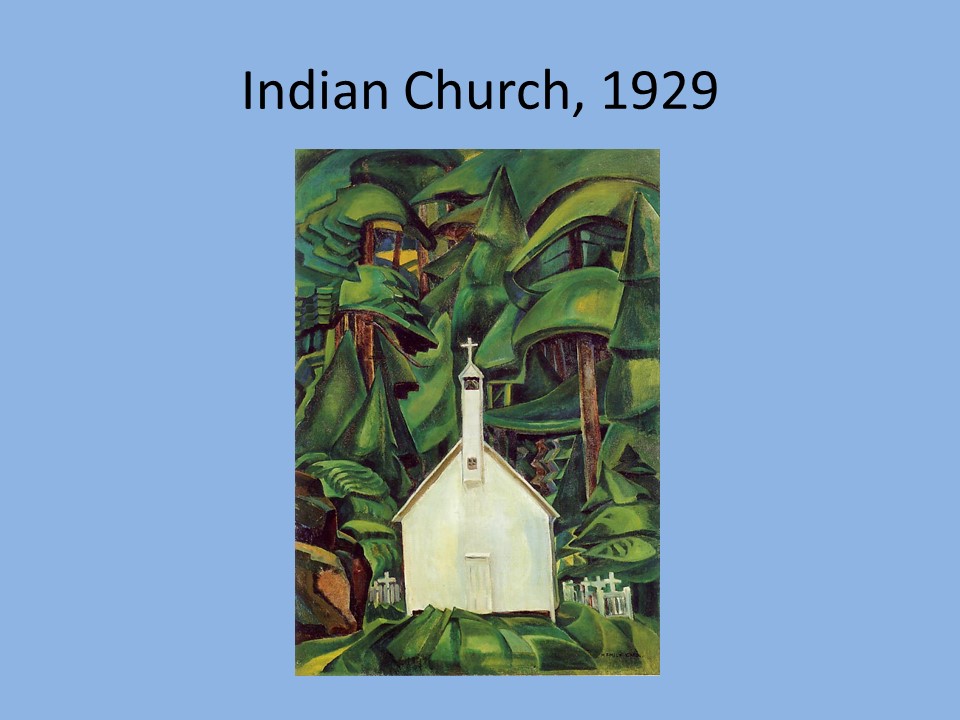
Do you go to Church? Many of us do. Emily Carr was raised in an Orthodox family where religion was an important part of their life. She and her sisters were expected to follow the rigid household and societal rules and attend church regularly. She considered herself spiritual but not religious, and she often avoided the prim and proper household rules by escaping into the forest.

What do you see as the main focal point? You probably first notice the white church, however look how Carr has engulfed it with the contrasting vibrant green trees. Is she giving the trees purpose and meaning. Do you see her use of shapes? What shapes do you see and where? Triangles and rectangles-church, crosses and trees. How does she show value? look at the shading among the trees. How many greens do you see? Notice the variants of colors. 


When you hear the word movement, what do you think of?  Body movement, transportation, maybe nature...movement was much a part of Carr's paintings. Notice the sweeping ground holding up the majestic raven. Nature and the bird become one. Why does she give this painting movement? Are the shapes you see organic?

Based on her early influences of time in France you will notice how parts of the sky is taking shape and form in the cubic style-the white rectangular sections. Carr had the luxury of meeting French artists and seeing their works. Afterwords, she approached painting by focusing on color, space, and light. What does Cubism mean? Can you name an artist in France who influenced Cubism? Picasso.


This painting was in 1931, It is on oil canvas, and is 112 x 68.8 cm. Do you see a repetition of shape in this painting? (cone)  Carr titled this painting The Little Pine, what do you think she is trying to tell the viewer about the tree?


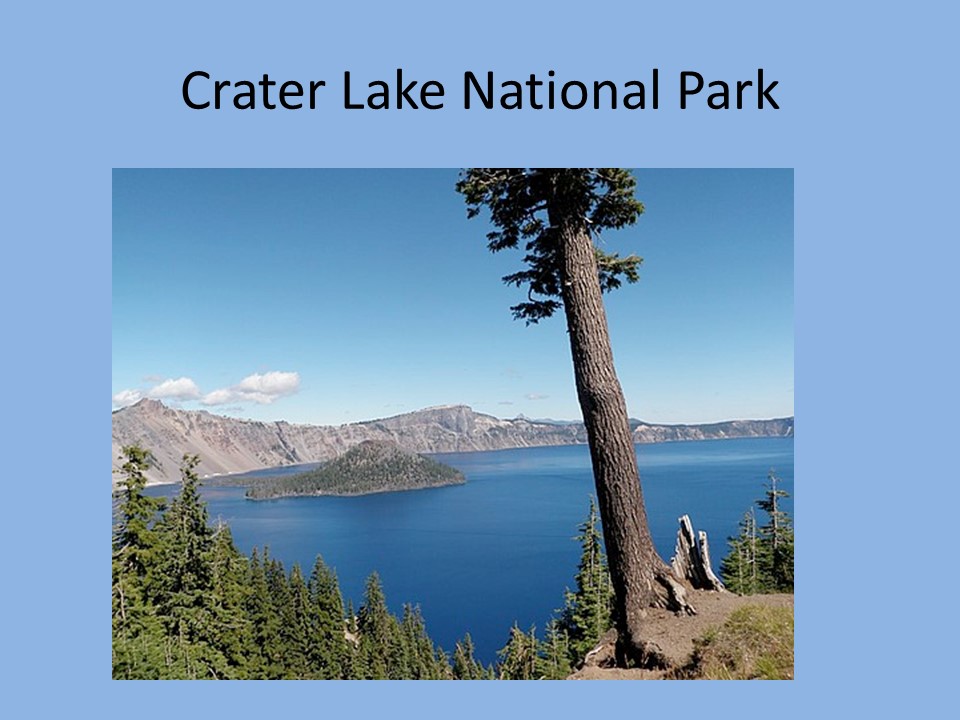
Emily Carr not only saw a decline in the villages and the people during a rise in English settlement, but she also witnessed changes to the forest.  Trees were being cut for wood. How does this painting make you feel? What is the artist trying to convey? Today we have environmentalists who have formed organizations to help create National acts to protect our National Parks and Forests-one example the Sierra Club. Carr may have been ahead of her time-a conservationist.  Can you name a National Park in our state here in Oregon? Crater Lake 

Notice the sky...can you think of another artist that painted similar skies and images (movement) in the style of Expression? Vincent Van Gogh  What does the sky tell you?


Here is another painting, painted on oil canvas ( 112.8 x 69 cm). She has abandoned her early teachings of depicting traditional representation of nature and landscapes. She uses motion and color to bring life to the forest. To Carr, the forest and all within were lifelike with a pulsing heart. Working quickly and spontaneously, she joyfully expresses the liveliness of the forest in a new and innovative way.  Can you imagine the ocean waves (a tsunami perhaps) sweeping through the forest? What would become of the trees? Does the "rushing sea" symbolize something?

Tidbit about Carr...During Carr's summer sketching trips, she traveled in a trailer, known as the "Elephant" along with her monkey, rat and four dogs. Realizing that she needed to make ends meet, she even raised and sold English bobtail sheepdogs. Do you think Emily Carr appreciated animals as well and nature?

One tree showing the transition from summer to fall. We can see that the tree is the main focal point, but what else do you see? Maybe a lake and a mountain...If we were to step into this painting to look closer to the tree, would we be standing in an elevated area? Can you think of a National Park in Oregon that I have mentioned earlier that may share some commonalities with this image...perhaps Crater Lake? The next picture is Crater Lake.


What are some differences in this picture? Colors, time of year, type of tree, position of the tree...
The following pictures are to give us an idea of how we would paint or draw like Emily Carr.  Let's try to have tree(s) be our focal points.


Emily Car was a Canadian artist born in Victoria, British Columbia. Carr's art was greatly influenced by the indigenous groups in the Pacific Northwest of Canada. Carr grew up in a two story house that is now known as the Emily Carr house and is a registered historical landmark in Canada.

Carr's parents died when she was only a teenager. Their death contributed to her decision to move to San Francisco. Carr realized her interest in art and enrolled in the California School of Design. When Carr finished school, she moved back to Victoria where she transformed a family barn into a painting studio. Carr worked on her own paintings and offered art classes to children. After a few years of working in her self-made studio, Carr decided to continue her education and moved to London to study at the Westminster School of Art. Carr was not fond of the climate in London and relocated numerous times to schools in Cornwall, Bushey and Hertfordshire England.

In 1910, Carr spent a year studying at the Academic Colarossi in Paris before settling in her native British Columbia. Carr was fascinated by the First Nations cultures and made several visits to the Nuu-chah-nulth, Kwakwaka'wakw, Haida, Tsimshian and Tlingit communities.  Carr picked up the practice of painting totem poles in order to leam more about the First Nations people. During this time, Carr made paintings influenced by the post-impressionist and fauvist styles she had learned during her stay in France.

In 1913, Carr returned to Victoria for financial reasons. Carr felt extremely isolated and unable to find artistic support. Carr stopped painting for several years and worked as a potter and dog breeder.

In 1920, Carr was invited to participate in a show at the National Gallery of Canada in Ontario titled "Canadian West Coast Art, Native and Modern".  At the exhibition Carr met the "Group of Seven"  a group of male artists who were focused on creating distinctly Canadian art.  Carr was accepted by the group and began showing with them. With greater acceptance, Carr's enthusiasm in painting was restored, and she made some of her best-known pieces. The Group of Seven sometimes referred to Carr as "The Mother of Modern Arts".

Carr had many exhibitions during the 1930's in prestigious locations such as the Art Gallery of Ontario and the Vancouver Art Gallery. Today, more than 200 of her works are part of the Vancouver Art Gallery's permanent collection. Carr has become an icon in Canada and an inspiration to women artists around the world