Pages

Tuesday, May 2, 2017

Henri Rousseau


Henri Rousseau was a self taught painter. He even read "How to Paint" books. After being a "Sunday Painter" for many years, at the age of 41 he devoted himself completely to his art. Although he was a contemporary of Gauguin, Cassatt, and Van Gogh, his style was different than theirs and completely his own. 

Rousseau's paintings are characterized by their fresh childlike quality. His imaginative use of exotic colors, and ideas give his works a mysterious, dream-like quality. He drew on his wide range of interests: wild beasts, the Jungle, war, love, flowers and death. 

The picture on the right is a self portrait of himself with a lamp. 


This painting was exhibited at the first public showing of the Salon Des Independents, and it created quite a (negative) sensation. While other independents could be described as leaders and inventors of new techniques, Rousseau was seen as an innocent who who disregarded all the refinement of French painting and all the achievements of optical illusion to create a "Puppet theatre on canvas"  Rousseau meticulous attention to detail in the tracery of the trees and the full moon in the night sky contrasted sharply with the harlequin figures seemingly hovering in front of this background. 


This picture was painted to commemorate the first international rugby match between France and England which took place in Paris in 1908, The composition is radical, with no transition between bird's eye perspective and frontal view, and the figures hover as if cut out and mounted, collage style, like puppets. The figure in the center, catching the ball to win the game, is Rousseau himself, continuing the theme of Rousseau's dreams of success and fame. 


This is one of 12 of Rousseau's still-life flower pictures that have been found. Unlike other artists, whose paintings were often designed to convey an illusion or idea. Rousseau's paintings were designed to capture the reality of objects or places that he could not own due to his poor circumstances. Rousseau approached his still-life methodically, carefully arranging the flowers by the type and color, placing the vase in the center of the canvas with absolute horizontal and vertical lines in the background. The effect is almost abstract, with no depth or dimension beyond the flat surface of the painting.


This is typical of Rousseau's portraits; the figure faces the front and is fixed in position with a precise outline, always sketched first. Since the face comes at the beginning and holds meaning, relatively little room is left beneath the huge head for the body. Details such as hands, accompanying objects, the pattern of a dress and legs are compressed. Since Rousseau constructed the figure additively, without regard to perspective foreshortening, it turns out in segments like the pieces of a puzzle. 


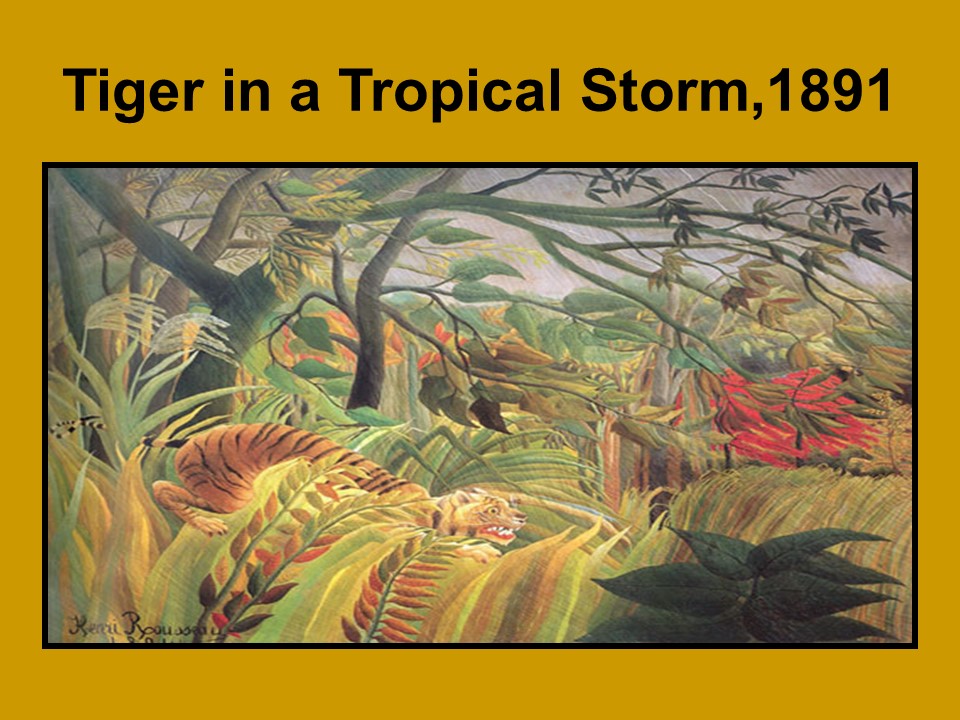
This was his first of many jungle scenes. Henri never went to a jungle he used his imagination. He did go to the local zoo for inspiration!


The beauty of nature was very important to Rousseau, and towards the end of his life he began to paint strange, exotic- almost surrealistic scenes featuring  wild animals and jungle themes. The innovative style of the jungle pictures brought a break-through for Rousseau; The Snake Charmer was commissioned by the influential Berthe Comtesse de Delaunay, mother of the painter Robert Dleaunay, and resulted in the attention and acceptance in exclusive Parisian circles that Rousseau craved. 

Typical of Rousseau's work, the painting is based on the strict reality of detail, and is built almost collage style. The botanical leaf provides the basic structure, with endless possibilities of repetition, variations, seriation and multiplication and including dozens of shades of green. The leaf guarantees the strict two-dimensionality which other more abstract artists could achieve only at the expense of meaning. Many minute details prevent the eye from resting on any central focus, and each part of the picture is given equal status, with no part subordinated to any other. Disproportionate forms, abrupt changes of color, and backdrops brought into the foreground all contribute to the complexity of the overall effect. 


Many of Rousseau's jungle pictures show some predilection for violence, perhaps indicating some hidden turbulence in the artist's character. The story is that Rousseau was so much in the grip of his imagination while painting these pictures that he felt stifled and afraid and head to open the window. 


Here we see bright colors and not a lot of detail. What do you see in this painting? 

Monday, March 6, 2017

M.C. Escher


First picture is a Self portrait done in lithographic crayon. The Dutch artist Maurits Cornelis Escher was was born in Leeuwarden, in the northern part of Holland, in 1898. Initially, he studied to be an architect, but he became increasingly interested in graphic art and eventually turned to being an artist. 

The second picture is a lithograph. We can see much from the reflection in the globe. The artist has drawn himself as well as the room in which he is sitting. 


Castrovalva another lithograph. His first works were very detailed realistic representations. Notice all the detail you can find in this work. As your eye travels over the landscape you will notice three villages and the roads connecting them. Look at the clouds that are coming over the mountainside. Can you tell which way the wind is blowing? 


The palm tree is a wood engraving-which is a print made from the carving on the end grain of a piece of wood. This particular piece is made from two blocks which make more color possible. Notice that while this work is done in black and white, there is also gray. 


Sky and Water I, woodcut. In 1935, when the artist was 37 years old he changed direction with his work. Up until then he had been mostly interested in improving his technique in representing realistic objects. Now, inspired by Moorish mosaics which he had seen in Spain when visiting the great Moorish mosques there, he began experimenting with techniques of tessellation and transformation. In a tessellation continuous and interlocking shapes cover the surface without overlapping or leaving gaps Transformation means that the shapes change from one image to another. Look at the top and bottom of this print. At the top there is a realistic bird, at the bottom an equally realistic fish. As your eye moves from the bird to the fish notice what happens to the space between the birds. It becomes the fish!


Continuing this theme, the artist explores the fish and birds again with this tessellation. This print is a woodcut which is different from a wood engraving in that it uses the front of a block, not the end. Sometimes you can notice the wood grain in a woodcut. 


Day and Night, woodcut from two blocks, Here we have a print which has incorporated both a landscape and a tessellation/transformation. At the bottom of the picture you can see two towns with a patchwork of a farmer's fields between them. The fields would be a tessellation, continuous and interlocking shapes covering the surface. As your eye moves upward you see the transformation, the fields become birds. Notice that there are both white and black birds. Which did you see first? Now notice that one of the towns is in darkness and the other is in light. The title of the print is Day and Night. Can you see how the black birds are flying through the daytime sky of one town, while the white birds are flying through the night sky of the other town? 


Puddle is a woodcut print. Here is another type of print that Escher experimented with. He called these next 3 images part of his experimentation with mirror images. Let's look carefully at this woodblock. We can be detectives as we find the tracks of two cars, two bicycles and two people walking. What time of day is it? Where is this mud puddle? 


Three Worlds is a lithograph. The artist called this print "Three Worlds" What levels can you see as you look into the pond? Do you see the fish swimming in the water? The leaves which float on top of the water? The trees reflected in the water?


First portrait is a lithograph. Here we have a drawing which represents many different points of view. Look at the top middle of the print. There are two people walking on a stairway. Notice that one of them is walking up the stairs and the other is walking down. That wouldn't be so strange, but they are walking in the same direction!

Second portrait is also a lithograph. By now your poor eyes must be thoroughly tricked! Here we see a lithograph of a structure with a waterfall. In fact, the artist has called it "Waterfall". Look at the background. It is a series of terraces. Notice how the terraces step down one after the other. Now look at the waterfall and follow the water with your eyes as it plunges over the fall and turns the water wheel. Then follow it as it flows downstream. It must be flowing downstream since water always flows downstream and besides look at the wall alongside the water. Don't the bricks step down every few bricks? The only problem is that if we continue to follow the water downstream we end up upstream ready to go over the waterfall again. What happened?!?


Drawing hands, lithograph. Here we have a piece of paper which is tacked to a surface. There is a hand which seems to be drawing a cuff of a sleeve. The cuff looks like a drawing. It sits flat on the paper. But out of that cuff comes a hand which seems to emerge right off the paper to grab a pen and draw another cuff connected to the first hand! What techniques have the artist used to make the hands look so three dimensional (rounded) while the cuffs look two dimensional (flat)? 


The rest of the pictures are examples of symmetry work. Look at each on and see the images that are in them. What do you think? 


Tuesday, December 13, 2016

Claude Monet
1840-1926


This photo was taken only 3 months before Claude Monet passes away. Although his sight was limited because of cataracts he still painted until he died in 1926.


As a young man of fourteen and fifteen, Monet would wonder around the beaches of his native LeHarve, making caricatures of tourists. He earned money about 10-20 francs for each caricature. 


Monet loved to paint the effect of light on a subject rather than the subject itself. Here we see early morning light on water. Water was one of Monet's favorite subjects. This painting gave impressionism its name. A journalist actually made fun of the painting, because it was not a complete painting it was only an "impression".  Despite this insult, Monet and his friends continued to exhibit their paintings. It would be ten years of ridicule and meager sales before impressionism became popular. 

Notice how the paint is applied in dots and dashes-an impressionists hallmark. 


Another Monet's favorite subjects; flowers, especially poppies. The boy in the foreground is his son, Jean. This painting is composed of colors, rather than forms. The lightness of the two puffy clouds is balanced by the pair of dark trees. The stretch of yellow sunshine against the grey line of the distant hills weights the right half of the picture (remember Leonardo how he painted the blue landscape in the distance also?). And Jean, surrounded by the bright flashes of red poppies brings the viewer's eye full circle. 

Monet did not make his pictures like Leonardo, sketching out each section and practicing form and placement. He quickly filled the entire canvas with tones, dabbing color everywhere and filling in the details as he went.  


Rather than paint staged pictures of historical or biblical subjects, the impressionist painted the every day world around them. Newly popular steam trains and the great glass architecture of the stations fascinated Monet, especially the effect of light on the steam. Monet painted this station  and its trains every day for 3 months, his first "series". You can still take the train to Givenry from this station. 

What draws your eye upwards? -peak of roof, steam. What balances it on the bottom?-dark color, solid form, tint vs. shade. What forms are repeated here?-circles, rectangles, organic and geometric forms. What keeps your eyes from wandering outside the station?- big puff of smoke. Where have we seen these clouds before?- previous painting also Leonardo's work.  


In the Haystack series, Monet sought to show the changes of light and atmosphere in each one. What time of day do you think this is?- Sunset. What kind of weather? Describe what is different about this painting compared with the train painting. Subject, choice of color, choppier brushstrokes, no atmosphere. 


Light radiates softly behind the hay, lighting the hills, trees, houses and fields. The peak of the haystack looks as if it is melting. 


Monet paid the farmer to leave the haystacks in the fields all winter so he could paint them. Notice how Monet balances the smaller haystack with the same amount and shape of negative space. Are there more tints of shades in this painting?-tints. Are there more warm or cool colors? - cool. Is this what you would expect? 


Monet moved to his country home in Giverny, 40 miles from Paris, in 1883. He virtually abandoned scenes of everyday life, to paint his garden and pond or "water landscape". He painted extensive gardens and created a pond with a Japanese footbridge as Japanese art was becoming popular in the late 1800's. This house, pond and garden survives virtually intact today. 
You can see the effect of photography (without which impressionism would never have begun) in this work. There are shadows on the path from trees we cannot see, outside the plane. 


Here we see the footbridge over the waterlily pond. 


This painting is probably a detail for Monet's last waterlily series which hangs in the Orangerie Museum in Paris. Monet had a large studio, and as he loses his sight, his canvas grows bigger. His brushstrokes are looser and freer, almost abstract. 


Notice the composition of this work. No horizon line, no background, little detail. What gives this painting balance? -equal tones, triangles. 


Contrast this painting with the last two. What is the difference? The same? How can you tell Monet did not paint this at the beginning of his career?

NW COASTAL PROJECT PICTURES


The kids got really creative in all of the classes for this project. Look at some of the totems made in Mr. Devlin's class today! Great Job 5th graders!!